
The Coordinates
This pull comes from the early experimental phase of Library Roulette, before coordinates became part of the official record.
Details
Published by: Knopf
Publish year: 2010
Dates Read: 17 June 2025 – 20 June 2025
JUDGING A BOOK BY ITS COVER
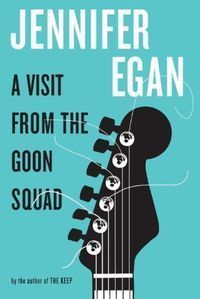
The image of the guitar headstock with the loose, untrimmed strings gave me flashbacks to the boys in high school who thought their garage band was going places. No shade to those guys — many were my friends and I loved their objectively shitty music.
I skimmed the dust jacket (I never read it completely) and picked up enough keywords that, combined with the cover art, had me assuming I was in for a story about the rise and fall of one such band. Maybe their band’s name is even The Goon Squad (great band name, by the way). I was expecting contemporary fiction built around music, a dreamed rise to fame, and the inevitable fallout. Because you can’t have rock and roll without the drugs and the sex, right?
I was wrong… kind of. The drugs and the sex are there and the music industry is there, but the story I thought I was getting isn’t the one Egan is telling.
What I Actually Got
A Visit from the Goon Squad is structured as a series of interconnected chapters, each operating almost as a standalone piece with different narrators, different tones, different vibes. One of the chapters is even in the form of a PowerPoint presentation. The timeline moves non-linearly across roughly five decades, from the 1970s to 2020. The music industry provides the setting with punk as a recurring motif, but this is not a story about music. It’s a story about time and identity, and how mortality and other people’s perceptions of us reveal or distort who we actually are.
If that sounds like a lot to hold together, it is. And yet, when you finish the final page, you realize you were able to put together the scattered pieces into a complete picture. This is a story of character development told from the point of view of side characters and passersby. The characters who are front and center in one chapter are background noise in another – and none of them are quite sure whose story they are actually telling.
The questions hidden underneath all of the timeline hopping and changing perspectives are what I really found interesting. How does our identity shift over time? How do we see ourselves in relation to how the people on the edges of our lives see us? What happens to personal authenticity in the age of digital connection? This last question is one that I feel aged well since the book’s 2010 publication. In a world where developing a personal “brand” online is increasingly the norm, are we trading our actual identities for likes and views?
OTHER THOUGHTS
This book gave me Daisy Jones and the Six vibes, but far more convoluted and considerably less entertaining.
Who Might Love This
If you are drawn to character study over plot momentum, this book is for you. If you don’t need a story to hold your hand through a tidy resolution and are comfortable with ambiguity and non-linear structure, you will likely find merit in this narrative style.
Who Should Probably Skip It
If you need a linear plot and story momentum to stay engaged, this book is going to lose you.
If you pick it up expecting a music story, you’re going to feel misled. The punk rock backdrop is real but it’s not the point.
Finally, if you have ADHD, as I do, this book will likely be a genuine slog. The disjointed structure that many readers praise may make it hard for you to hold the story together. If your attention drifts, there is no clear anchor to return to.
Final Roulette Verdict
Selective Appeal – Not for me, but someone will love it.
 The Library Roulette Project
Leave a comment